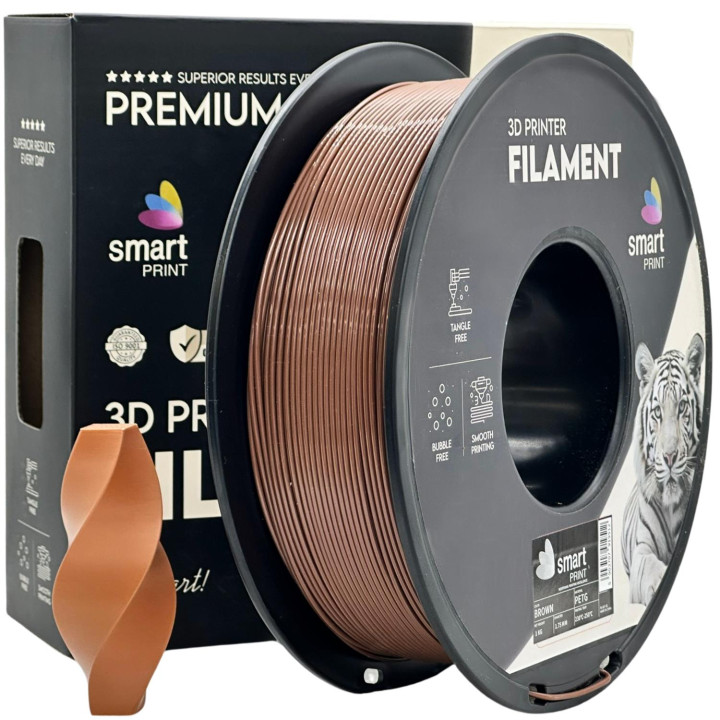
Smart Print PETG filament 1.75mm 1kg | Brown – Engineered Strength with the addition of Premium Inhibitors
Take your prints into the area of advanced mechanical and environmental applications. Professional Smart Print PETG filament in a deep, subdued Brown color is a modern engineering material that ideally combines the best features of the two most popular polymers. It offers structural strength and thermal resistance similar to ABS materials, while maintaining excellent dimensional stability and ease of printing known from traditional PLA.
Thanks to the use of a unique formula saturated with specialized modifiers and structural inhibitors, this material is characterized by increased mechanical resistance and perfect color depth and stability along the entire length of the roll. The material is slightly flexible, which translates into outstanding impact strength and resistance to cracking under the influence of dynamic stresses. PETG is naturally insensitive to moisture, water and a wide range of chemicals and acids. The deep brown shade with a delicate glass-satin sheen gives the models a professional look and perfectly masks the layer boundaries. It is an ideal choice for the production of functional parts, moving mechanisms, housings operating in difficult conditions, handles and outdoor applications. The product works with most open FDM/FFF 3D printers.
Why is it worth choosing Smart Print PETG engineering filament?
- Formula with strength & color inhibitors: Special laboratory additives permanently increase the interlayer bond in the Z axis and guarantee impeccable stability of the brown pigment during plasticization at high temperatures.
- Dimensional stability (Low Warping): Minimal thermal shrinkage allows for trouble-free printing of large engineering details without the risk of corners peeling off the print bed.
- High mechanical and chemical resistance: The modified copolyester structure provides excellent resistance to impacts, friction and the effects of detergents, oils and atmospheric factors.
- Rigorous precision of diameter: Fixed line size of 1.75 mm with a tolerance of up to ±0.03 mm guarantees fully stable material dosage, preventing blocking of the extruder.
Technical parameters and suggested settings:
Filament diameter:
1.75 mm (geometric tolerance: ± 0.03 mm)
Color / Finish:
Brown (Brown / Subtle shine)
Plastic type:
PETG (Polyethylene terephthalate with glycol)
Net weight of the material:
1.0 kg (gross weight with packaging: ~1.3 kg)
Nozzle Temperature (Nozzle):
220°C – 240°C
Table temperature (Bed):
80°C – 90°C (heated bed absolutely required)
Spool dimensions:
Outer diameter: 195 mm | Centering hole: 75 mm
Producer / Country of origin:
Imagine s.c., Cholerzyn (Poland)
Recommendations and working tips for PETG material:
PETG is a material with very strong adhesion to some surfaces, which requires appropriate preparation of the working platform.
• Table surface protection: Due to the extremely strong adhesion of PETG to clean glass or smooth PEI boards, it is recommended to use separating agents (e.g. PVA glue, dedicated adhesive varnishes). This prevents the risk of damaging the table surface when removing the finished model.
• Cooling control: To obtain maximum mechanical strength and cohesion of the layers, it is recommended to limit the cooling airflow (suggested values: 20-50% depending on the geometry). Too intense airflow may weaken polymer bonds.
• Compatibility: Fully compatible with Prusa, Bambu Lab, Creality (Ender), Anycubic devices and other 3D printers supporting nozzle temperatures up to 240°C.
Packing and storage information:
The filament is wound on a stable, stiff spool in a completely orderly manner, which prevents the line from crossing and tangling during many hours of work sessions. Each spool is factory-packed and hermetically packed in a thick barrier foil in a vacuum cover with an active moisture absorber (silica gel).
Tip: PETG plastics have a natural tendency to absorb moisture from the air superficially (hygroscopicity). After opening the package, it is recommended to store the spool in a dry place, a dedicated dry box container or a tight string bag with an absorbent. If the material becomes damp, it is worth drying it before printing (approx. 60°C for 4-6 hours), which will completely eliminate threading (stringing) and the formation of air bubbles in the structure of the walls.


Comments (0)
Your review appreciation cannot be sent
Report comment
Report sent
Your report cannot be sent